

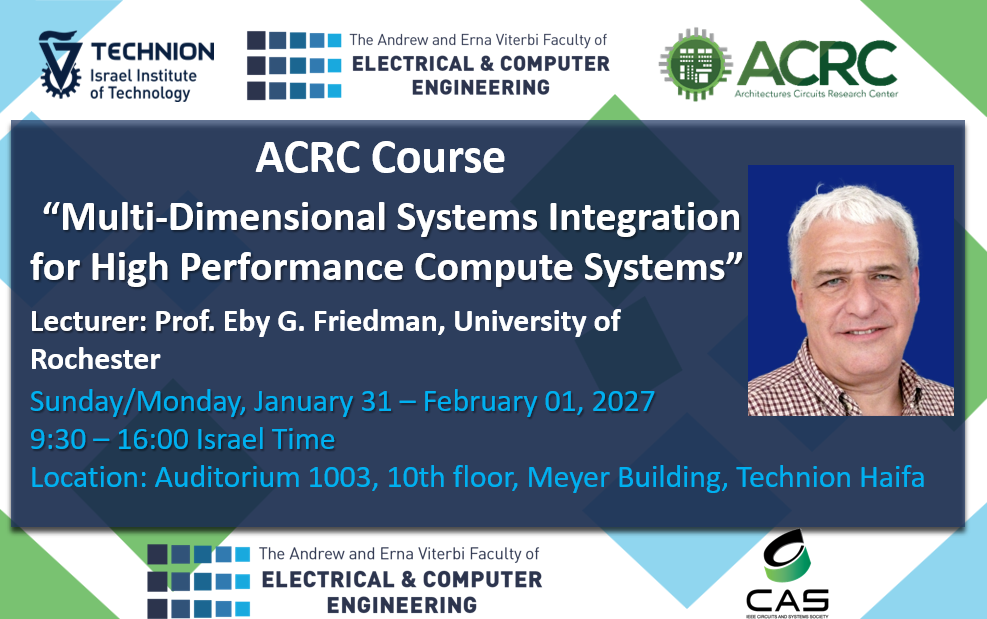
| Instructor: | Prof. Eby G. Friedman, University of Rochester |
| Lectures: | 2 days |
| Academic Points: | No academic points |
| Course Fees: | TBD |
For registration, click here
Registration closes on Januray 24th, 2027
Date: Januray 31 – February 01, 2027
Time: 9:30 – 16:00 Israel Time
Location: Auditorium 1003, Meyer Building, Technion
Language: English
Bio:
Eby G. Friedman was with Hughes Aircraft Company from 1979 to 1991 and has been with the University of Rochester since 1991, where he is a Distinguished Professor. He is also a Visiting Professor, co-director of the ACRC, and member of the board of governors of the Technion—Israel Institute of Technology. He has authored more than 600 papers and book chapters, 29 patents, and authored or edited 22 books in the fields of high speed and low power CMOS design techniques, 3-D design methodologies, high speed interconnect, superconductive circuits, and the theory and application of synchronous clock and power distribution networks. His current research and teaching interests include high performance synchronous digital and mixed-signal circuit design and analysis with application to high speed portable processors, low power wireless communications, data centers, and quantum computing.
Dr. Friedman is a recipient of the IEEE Circuits and Systems Mac Van Valkenburg Award, IEEE Circuits and Systems Charles A. Desoer Technical Achievement Award, University of Rochester William H. Riker University Award for Graduate Teaching, College of Engineering Teaching Excellence Award, and Hajim Lifetime Achievement Award. He is a past Editor-in-Chief and Chair of the steering committee of the IEEE Transactions on Very Large Scale Integration (VLSI) Systems, past Editor-in-Chief of the Microelectronics Journal, Regional Editor of the Journal of Circuits, Systems and Computers, an editorial board member of numerous journals, and a program and technical chair of several IEEE conferences. He is an IEEE Fellow, Fellow of the National Academy of Inventors (NAI), Senior Fulbright Fellow, National Sun Yat-sen University Honorary Chair Professor, and an inaugural member of the UC Irvine Engineering Hall of Fame.
Abstract:
The landscape of compute systems is widening at an accelerating rate, requiring novel and different topologies and technologies. Multi-dimensional systems, such as 3-D, 2.5-D, 3.5-D, and multiple chiplets, have become a primary path to large scale integration. These systems topologies and underlying technologies greatly affect the overall electrical, optical, mechanical, and thermal characteristics of these extreme scale systems. These systems are highly multi-dimensional in nature, composed of many vertically integrated layers, interacting across a variety of system functions and technologies. These complex compute systems are driven more than ever to extreme performance levels, requiring novel systems integration topologies and technologies that are increasingly important. An important trend to support large scale integrated systems is the application of widely applied stacking and chiplet technologies in which several layers of active substrates are vertically interconnected. In this way, highly compact, high performance compute systems have become feasible. These compute systems are therefore much more than a single silicon die placed within a package with some wires.
This seminar will review key issues in multi-dimensional design and related technologies. Topics that will also be discussed include on-chip interconnect, power delivery, synchronization, network communication, thermal behavior, and heterogeneous integration; specifically targeting multi-dimensional systems. The focus will be on both current and near term capabilities. These next generation vertically integrated technologies are now becoming available, allowing the development of extreme large scale systems composed of multiple vertical layers, passive and active interposers, and a variety of chiplets (often treated as IP blocks) to produce extreme large scale systems operating at increasingly higher levels of performance.
For registration, click here