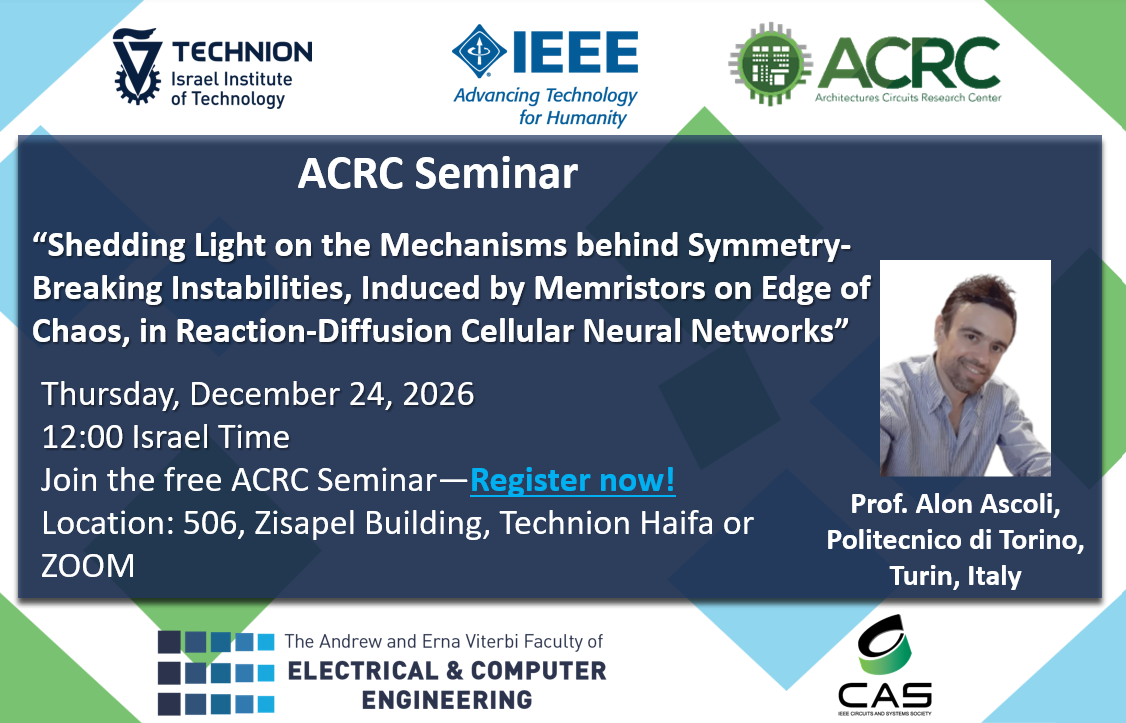
Speaker: Prof. Alon Ascoli, Politecnico di Torino, Turin, Italy
Date: Thursday, December 24, 2026
Time: 12:00 – 13:30 Israel Time
Language: English
Location: Room 506, Zisapel Building, Technion Haifa.
You can also join via Zoom.
Register Here!
Abstract:
In this talk, we employ a novel analysis approach, based upon frequency-domain methods,
which are typically employed in Control Theory [1], to explore the origin for Turing Instabilities [2] in Reaction-Diffusion Cellular Neural Networks (CNNs) [3]-[4], leveraging Memristors on Edge of Chaos [5]-[6], fabricated at NaMLab [7]-[8], from a new perspective. The predictions, drawn from the theoretical investigation, shedding light on earlier-overlooked yet-critical subtleties behind these
emergent phenomena, are validated against the outcome of numerical investigations, for various
resistively-coupled Cellular Neural Networks, differing one from the other for the circuit topology of
the basic reaction cell. Given that neurons couple together in well-defined clusters for specific time
windows, depending upon the computational problem, they aim to solve, thus implementing sparse
spatio-temporal paradigms to code and process information in an energy-efficient form, studying the bifurcation phenomena [9], leading to the steady-state formation of static [10] or dynamic patterns [11], which may possibly emerge across bio-mimetic cellular arrays, depending upon the clusters of reaction cells, which adaptive synaptic couplings let interact via diffusion processes, may inspire the design of innovative neuromorphic networks [12]-[15] mimicking bio-plausibly the operating principles of the human brain.
Acknowledgement: This research study was financially supported by the DFG in the framework of the project 528378584 “Under Voltage Control: Nb2O5 Based Locally Active Threshold Switches,” belonging to the CRC/TRR programme 528378584 “TRR 404 Next Generation Electronics with Active Devices in Three Dimensions (Active-3D)”.
Bibliography:
[1] C.H. Houpis, and S.N. Sheldon, “Linear Control System Analysis and Design with Matlab,” 6th edition, CRC Press, 729pp., 2013, ISBN-13: 978-1466504264 2013
[2] A. M. Turing, “The chemical basis of morphogenesis,” Philos. Trans. Royal Soc. London, B, Biol. Sci., vol. 237, pp. 37-72, Aug. 1952
[3] L.O. Chua, “CNNs: A Paradigm for Complexity,” World Scientific Publishing Co Pte Ltd, 332pp., 1998, ISBN13: 978-9810234836
[4] V. Ravichandran, Y. Huang, B. Flannery, T. Molom-Ochir, T. Maurer, S. Asapu, A. Abdel-Maksoud, N. Heermance, R. Yoo, J. Tackie, W. Zhao, Y. Ling, A. Guo, J.J. Yang, and Q. Xia, “Memristive cellular neural networks for fast in-pixel computing,” Nature Electronics, vol. 9, no. 2, pp. 189-199, 2026
[5] L.O. Chua, “Memristors on ‘edge of chaos’,” Nature Reviews Electrical Engineering, vol. 1, pp. 614-627, 2024
[6] S.J. Kim, T. Wang, R. Zhao, D. Rossetti, Y. Xu, J. Zhao, A. Ascoli, F. Corinto, R. Stanley Williams, and J.J. Yang, “Diffusive memristors in the edge of chaos,” Nature Communications, vol. 17, no. 7920, pp. 1-10, 2026, DOI: 10.1038/s41467-026-74640-6
[7] A. Ascoli, A.S. Demirkol, R. Tetzlaff, S. Slesazeck, T. Mikolajick, and L.O. Chua, “On Local Activity and Edge of Chaos in a NaMLab Memristor”, Frontiers in Neuroscience, vol. 15, no. 651452, 30pp., 2021, DOI: 10.3389/fnins.2021.651452
[8] https://www.namlab.com/
[9] A. Ascoli, A.S. Demirkol, N. Schmitt, R. Tetzlaff, and L.O. Chua, “Edge of Chaos Behind Bistability of the Inhomogeneous in Homogeneous Cellular Media,” Proc. of the IEEE Int. Conference on Metrology for Extended Reality, Artificial Intelligence and Neural Engineering (MetroXRAINE), Rome (Italy), 2022, DOI: 10.1109/MetroXRAINE54828.2022.9967680
[10] A. Ascoli, A.S. Demirkol, L.O. Chua, and R. Tetzlaff, “Edge of Chaos is Sine Qua Non for Turing Instability,”IEEE Trans. Circuits and Systems-I (TCAS-I): Regular Papers, vol. 69, no. 11, pp. 4596-4609, Nov. 2022, DOI: 10.1109/TCSI.2022.3194465
[11] A. Ascoli, A.S. Demirkol, L.O. Chua, and R. Tetzlaff, “Edge of Chaos Theory Resolves Smale Paradox,”IEEE Trans. Circuits and Systems-I (TCAS-I): Regular Papers, vol. 69, no. 3, pp. 1252-1265, 2022, DOI:10.1109/TCSI.2021.3133627
[12] Sung Mo Kang, D. Choi, J.K. Eshraghian, P. Zhou, J. Kim, B.S. Kong, X. Zhu, A.S. Demirkol, A. Ascoli, R. Tetzlaff, W.D. Lu, and L.O. Chua, “How to Build a Memristive Integrate-and-Fire Model for Spiking Neuronal Signal Generation,” IEEE Trans. Circuits and Systems-I (TCAS-I): Regular Papers, vol. 68, no. 12, pp. 4837-4850, 2021, DOI: 10.1109/TCSI.2021.3126555
[13] W. Yi, K.K. Tsang, S.K. Lam, X. Bai, J.A. Crowell, and E.A. Flores, “Biological plausibility and stochasticity in scalable VO2 active memristor neurons,” Nature Communications, vol. 9, no. 4661, 10pp., 2018, DOI: 10.1038/s41467-018-07052-w
[14] M.D. Pickett, and R.S. Williams, “Phase transitions enable computational universality in neuristor-based cellular automata,” Nanotechnology, vol. 24, no. 38, 384002(7pp.), 2013, DOI: 10.1088/0957-4484/24/38/384002
[15] S. Kumar, R.S Williams, and Z. Wang, “Third-order nanocircuit elements for neuromorphic engineering,” vol. 585, no. 7826, pp. 518-523, Nature, 2020, DOI: 10.1038/s41586-020-2735-
Bio:
A. Ascoli achieved a First Class Honors Master of Science Degree in Electronic Engineering at Universita’ degli Studi Roma Tre in 2001, and a Ph.D. degree in Electronic Engineering at University College Dublin in 2006. He serves the Department of Electronics and Telecommunications of Politecnico di Torino as Associate Professor since 2023. He was previously affiliated for 11 years with the Chair of Fundamentals of Electronics at Dresden University of Technology, where he was conferred the prestigious Habilitation title in Nonlinear Circuit Theory in 2022. He has a strong expertise in the modelling and investigation of nonlinear devices, circuits and systems. In particular, he has developed predictive physics-based compact models for memristor nanodevices from the non-volatile and volatile classes, discovered various peculiar phenomena, occurring in memristive physical media through ad-hoc theoretic investigations, and designed bio-inspired circuits and networks, extending the functionalities of state-of-the-art electrical systems. He is especially admired for pioneering theoretico-experimental studies, involving the design of reaction-diffusion cellular arrays, hosting locally-active threshold switches, for explaining longstanding open questions in science, including Turing’s instability problem and Smale’s paradox. He was a recipient of the Best Paper Award from the International Journal of Circuit Theory and Applications (IJCTA) in 2007, and of the Darlington Best Paper Award from IEEE Transactions on Circuits and Systems in 2023. He served IEEE CASS as Associate Editor for the Transactions on Circuits and Systems (TCAS-I) over the 2023-2025 three-year term, and as Senior Area Editor for the same Journal over the 2024-2025 two-year time frame. He has been the President of the IEEE Circuits and Systems Society (CASS) Technical Committee (TC) on Cellular Nanoscale Networks and Array Computing (CNNAC) from 2019 to 2021. He has been the President of the IEEE CASS TC on Cellular Nanoscale Networks and Memristor Array Computing (CNN-MAC) from 2021 to 2023. Prof. Ascoli is a member of the Chua Memristor Center (CMC) since its establishment in 2016.
He is involved in the newly-approved COST Action proposal European Network on NeuroMorphic
Computing (EuroNMC). As DFG Mercator Fellow for the project SFB/TRR404, involving scientists at NaMLab gGmbH, he is currently a Visiting Professor at the Chair of Nanoelectronics of Dresden
University of Technology hosted by Prof. Thomas Mikolajick
The seminar is free but registration is required!
Register Here!